Elyra Systems
Live URL: https://www.elyrasystems.com/
A hospitality product story about connecting inbound communication, reservations, and day-to-day host operations into one AI-assisted system.
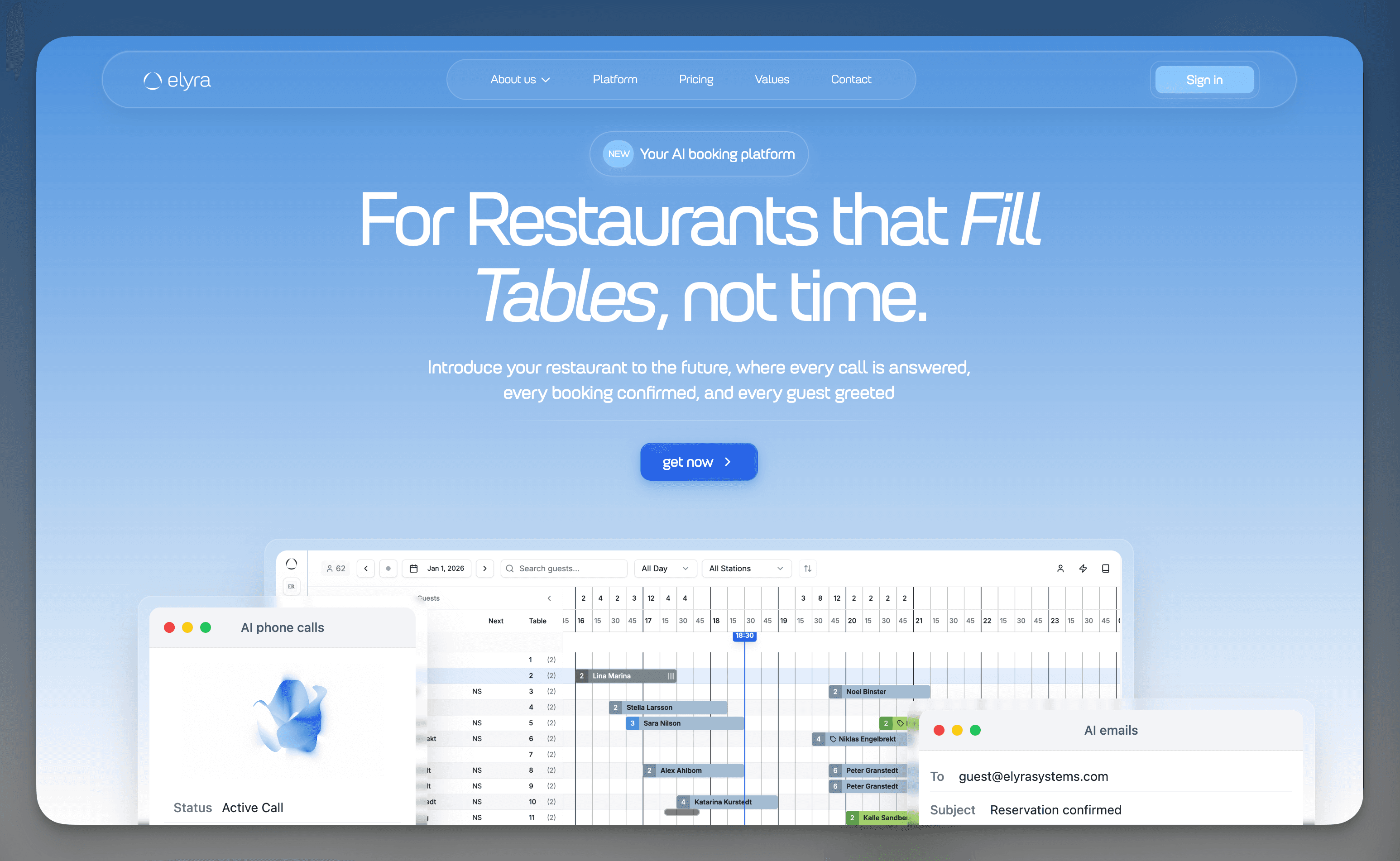
Elyra sits at the intersection of two high-pressure restaurant realities: guest communication volume and operational bottlenecks around reservations, tables, and handovers. The product needed to behave like an operations system, not just a chatbot surface.
What we were solving
The first problem is missed demand. Restaurants lose covers when calls are missed, handled late, or resolved inconsistently across shifts. Voice and email channels needed structured automation so enquiries could be captured and converted reliably.
The second problem is fragmentation between communication and floor operations. Booking requests, table allocation, notes, and follow-ups often live in separate tools. Elyra had to unify these flows so staff actions and guest interactions stayed synchronized.
Build scope
- Restaurant-specific AI positioning across voice, email, and booking workflows
- Reservation and customer communication automation narrative for hospitality teams
- Operational product framing for host-side workflows like table and booking handling
- SaaS conversion surfaces across pricing, contact, and trust-building content
System and workflow design
We treated Elyra as a communication-to-booking pipeline. Voice and email agents were positioned as front-line intake, while downstream booking and host workflows handled assignment, confirmation, and operational follow-through.
The platform narrative focused on practical automation outcomes: 24/7 call handling, reservation capture, and customer communication consistency. Messaging emphasized reliability for hospitality teams rather than generic AI capability claims.
Under the hood, workflow depth matters. The product surface indicates support for booking management, table-level decisioning, and host productivity context, which makes the system more operationally credible than a simple lead-capture assistant.
Commercially, the site architecture supports SaaS conversion with clear pricing and contact routes while preserving trust signals through product framing, structured FAQs, and restaurant-specific use-case language.
Step 01
Capture
How are guest calls and messages handled every time?
The first layer is channel coverage. AI voice and email agents are presented as always-on intake so booking intent and guest questions are captured consistently, regardless of staffing pressure or time of day.
Step 02
Orchestrate
How does communication become operational action?
Captured interactions need to flow into reservation operations. Elyra's product shape links communication events with booking workflows so confirmations, updates, and assignment decisions stay connected.
Step 03
Optimize
How do teams improve service and throughput over time?
Beyond handling single interactions, the platform points toward host productivity and operational visibility. That creates a feedback loop where teams can refine response quality, table usage, and booking performance.
How the user moved through the product
Receive guest intent
A guest reaches the restaurant through call or message. Instead of risking missed contact, the AI layer captures the enquiry and starts a structured service path.
Convert into a reservation flow
The request is translated into booking context with the key details needed for follow-through, reducing manual back-and-forth and improving response consistency.
Coordinate host operations
Reservation data and operational context are handled inside host workflows where tables, timing, and booking updates are managed as part of daily service operations.
Follow up and retain
Post-booking communication continues through automated channels, helping venues maintain guest trust while reducing repetitive manual communication tasks.
What we learned building it
Vertical specificity makes AI products clearer
Elyra's positioning works because it speaks directly to restaurant operations. Framing around calls, bookings, and host workflows creates stronger relevance than broad automation messaging.
Automation needs an operations backbone
Communication automation alone is not enough. Value increases when calls and messages feed directly into booking and floor-management workflows that teams already rely on.
Reliability matters more than novelty in hospitality
For restaurants, consistency is the differentiator. The strongest product promise is not just AI capability, but dependable handling of guest interactions during peak operational load.
Conversion improves when technical claims map to service outcomes
The clearest route to buyer confidence is translating AI features into practical outcomes: fewer missed bookings, better response quality, and smoother day-to-day host execution.